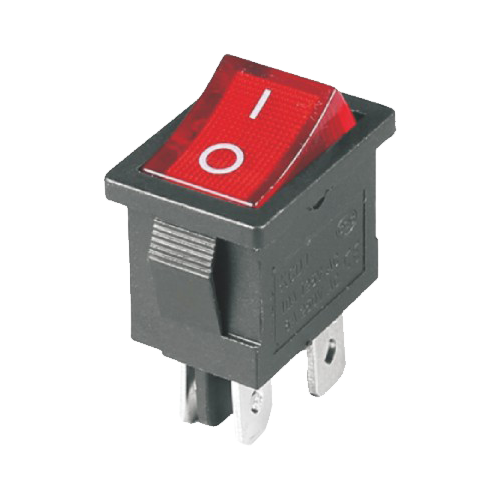
Rocker switches play a critical role in modern power and electronic systems. Their applications span industrial equipment, household appliances, automotive electronics, and various power devices, requiring them to withstand diverse and demanding environmental and operational conditions. Under the influence of electrical surges and electromagnetic interference (EMI), the stability of rocker switches directly impacts the safety and reliability of the entire system. This article delves into key design considerations for rocker switches in mitigating electrical surges and EMI, analyzing how design strategies and material selection can enhance their stability to meet stringent requirements in power equipment, automotive electronics, and other applications.
I. Causes of Electrical Surges and Surge Protection Design for Rocker Switches
1. Causes and Hazards of Electrical Surges
Electrical surges refer to transient overvoltages occurring in power systems, typically caused by lightning strikes, motor startups, circuit breaker operations, or switching of other electrical equipment. These surges can be destructive to electronic components. When subjected to surges, rocker switches may suffer damage, overheating, or even fire due to excessive current or voltage. In industrial and automotive electronic systems, such sudden events not only disrupt equipment operation but also pose risks to user safety.
2. Design Approaches for Surge Protection in Rocker Switches
To achieve effective surge protection, rocker switch designs should focus on the following aspects:
Material Selection: Materials used in switches must exhibit excellent high-voltage and high-temperature resistance during surge events. Copper and silver alloys are commonly used as conductive materials due to their low contact resistance under high current. For housing materials, thermoplastic polymers and high-performance engineering plastics demonstrate superior heat and voltage resistance, effectively protecting internal structures from thermal damage.
Contact Structure Optimization: Surge currents often cause contact erosion and wear, reducing contact reliability. Designing multi-point contact structures helps distribute current flow, reducing load on individual contact points and minimizing erosion risk. Additionally, silver- or gold-plated contacts further lower contact resistance and enhance durability.
Integration of Protective Components: To improve surge tolerance, surge protection components such as metal oxide varistors (MOVs) or gas discharge tubes (GDTs) can be integrated within or around the switch circuitry. MOVs instantly absorb large amounts of energy during surges, clamping surge voltages to safe levels, while GDTs conduct under high transient voltages to protect the switch from damage. Such surge protection designs are particularly suitable for automotive electronics and power equipment.
3. Application Example: Surge Protection Design in Automotive Electronics
Automotive electronic systems frequently experience surges during engine start-up or motor switching, imposing high demands on onboard rocker switches. For instance, rocker switches used in window controls or air conditioning systems require contacts capable of withstanding instantaneous high currents. One automotive manufacturer significantly reduced surge-related degradation by integrating MOVs and high-temperature-resistant alloy materials into their rocker switches, extending switch lifespan by over 20% while ensuring system stability and safety.
II. Electromagnetic Interference (EMI) and Electromagnetic Compatibility (EMC): Impact and Optimization Strategies for Rocker Switches
1. Causes and Challenges of Electromagnetic Interference
Electromagnetic interference arises from external or internal electromagnetic signals that disrupt normal electronic device operation, including electrostatic discharge, radio-frequency interference, and power supply noise. For rocker switches in industrial equipment and power systems, EMI can cause switch malfunction, signal deviation, or even erroneous operation. Therefore, EMI/EMC optimization is crucial to ensure reliable performance of rocker switches in high-frequency and complex electromagnetic environments.
2. EMI/EMC Optimization Strategies for Rocker Switches
Shielding Design: Adding internal metal shielding layers or incorporating conductive materials (e.g., carbon fiber or aluminum-coated materials) into the switch housing effectively blocks external EMI. These conductive materials absorb external electromagnetic waves and dissipate interference through grounding, ensuring stable electrical signal transmission.
Integration of Filtering Components: Incorporating filtering capacitors or inductors into the switch circuit design reduces high-frequency noise interference. For example, RC filter circuits suppress high-frequency signals; by tuning capacitance and resistance values, they effectively eliminate high-frequency pulses generated during switch disconnection.
Optimized Switch Layout and Grounding Design: Careful PCB layout and grounding arrangements minimize coupling between the switch and adjacent circuits. In industrial automation equipment, proper grounding and layout significantly reduce mutual inductance interference, thereby enhancing EMI immunity.
3. Application Example: EMI/EMC Optimization in Industrial Automation Equipment
EMI/EMC issues are especially prominent in industrial automation equipment. One manufacturer addressed this by incorporating conductive plastics into the rocker switch housing and integrating filtering capacitors into the switch circuitry. This approach effectively reduced the impact of high-frequency interference on switch signals, improving equipment stability. Additionally, optimized grounding layouts minimized operational errors and signal deviations, meeting the high anti-interference demands of industrial applications.
III. Future Trends in Stability Design for Rocker Switches
1. Intelligent Adaptive Protection Systems
Future rocker switch surge protection designs will increasingly adopt intelligent approaches. By embedding microcontroller units (MCUs) and smart sensors, rocker switches can monitor real-time current fluctuations and automatically disconnect circuits or activate protection modes upon detecting abnormal voltage or current, thereby enhancing surge resilience. For example, in smart power systems, real-time monitoring and adaptive switching not only protect the switch but also optimize overall energy efficiency.
2. Application of Advanced and Composite Materials
Material advancements will further expand rocker switch applications in extreme environments. Graphene offers exceptional conductivity and EMI resistance, while composite materials provide superior heat resistance and impact strength, making them promising candidates for next-generation surge- and interference-resistant designs. For instance, applying graphene-based materials to conductive pathways or using composites for housings could significantly enhance durability and EMI immunity.
3. Integrated EMI/EMC Solutions
To meet the demands of complex electromagnetic environments, future rocker switch designs will increasingly adopt integrated EMI/EMC solutions. Examples include rocker switches with built-in shielding and filtering functions, providing comprehensive interference protection within the switch itself and reducing the need for additional external circuitry. Such integrated solutions are particularly beneficial for industrial control systems, medical devices, and power systems with stringent EMI/EMC requirements.
Conclusion
To address the challenges posed by electrical surges and electromagnetic interference, the stability design of rocker switches must integrate material selection, structural optimization, shielding techniques, and filtering measures. This ensures their reliability and durability in demanding applications such as power equipment, industrial automation, and automotive electronics. Looking ahead, continuous advancements in intelligent protection, novel materials, and integrated EMI/EMC solutions will further enhance the stability and adaptability of rocker switches, providing robust support for the safe and efficient operation of power and electronic systems.
2025-10-09
返回上一页